How to Review a Silk Scrunchie Sample Before Bulk Production
Use a written silk scrunchie sample review to inspect fabric coverage, seam position, elastic recovery method, branding and packout before bulk approval.
Review the matched product or buyer guide selected in this article.
On this page
- Quick answer: review the sample in a controlled sequence
- Build the written specification before handling the sample
- Inspect fabric coverage, seam position and the elastic join
- Run an agreed elastic recovery observation
- Compare every size or assortment SKU separately
- Review branding and packout on the assembled unit
- Use pass, conditional and revise outcomes
- Retain the approved sample and hand off the bulk record
- Silk scrunchie sample approval checklist
- FAQ
- Can a product photo prove elastic recovery?
- Should every scrunchie use the same stretch ratio and cycle count?
- Does a passed sample guarantee the bulk order?
- What if one colour in a multi-pack changes?
- What should we send for a project-specific review?
- Request a project-specific sample review
A silk scrunchie sample should be approved against a written specification and a repeatable observation method, not only against a product photo. Before bulk production, record the selected silk, finished size reference, fabric coverage, elastic feel and recovery method, elastic join, seam position, branding, packout and decision owner. The sample can then finish as pass, conditional approval or revise, with the approved reference retained for production.
For private label and wholesale buyers, the purpose is to make an approval decision that production and sourcing can both trace. OlaSilk is a Qingdao source factory supporting custom silk projects. Current public planning facts include 100% mulberry silk products, MOQ from 10 pieces in stock colors (custom Pantone dyeing carries a higher dye-lot minimum), a sample lead time of about 7 days and a bulk lead time of about 25 days. OlaSilk states that its mulberry silk is OEKO-TEX STANDARD 100 certified and that the factory has Sedex and ISO 9001 certifications. These are starting points rather than an automatic quote: confirm the exact material, quantity, construction, test, timing and certification document scope for the named project.
Buyer decision: decide whether one named sample is ready to become the production reference, which corrections are still open and who has authority to release it.
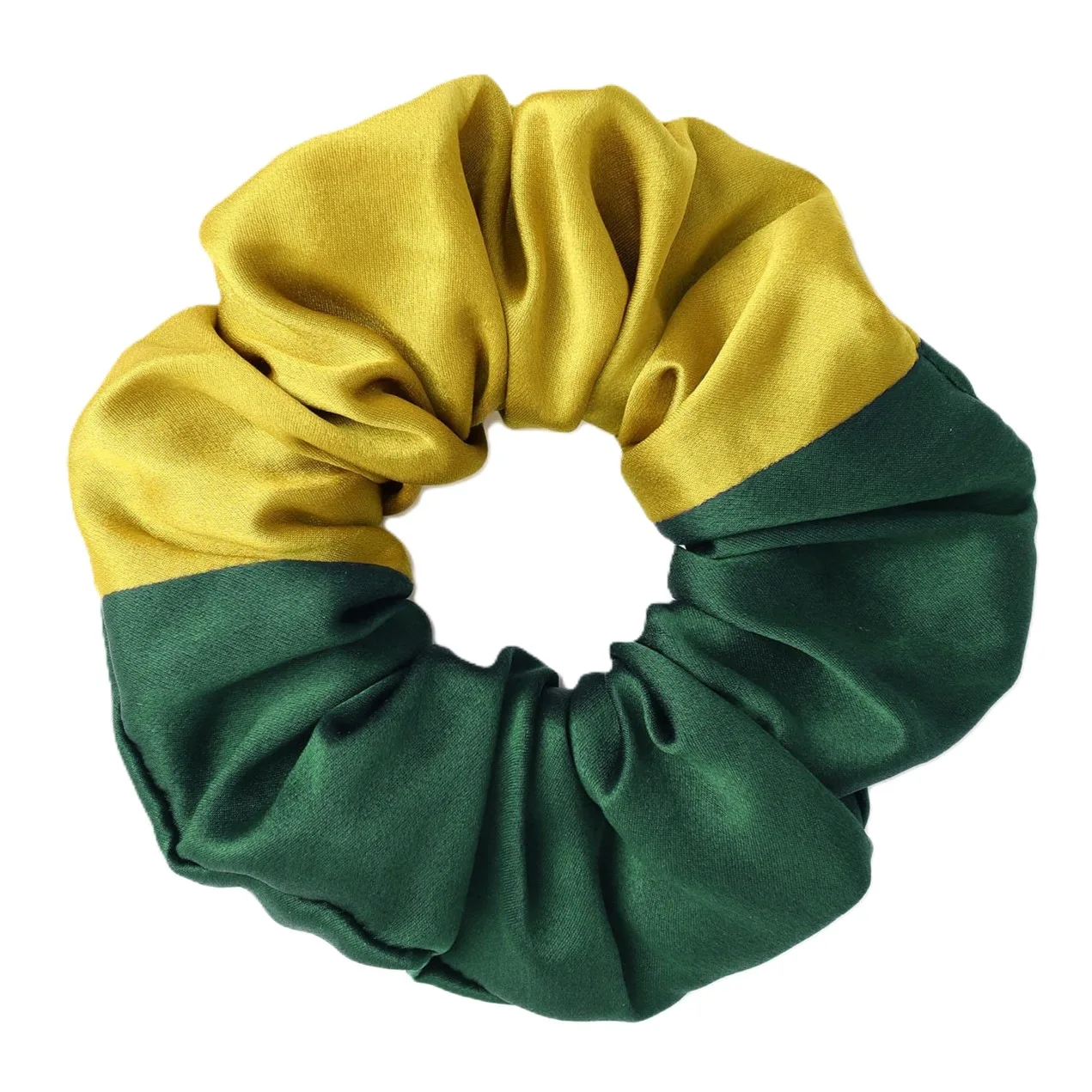
The image above is a real OlaSilk colorblock scrunchie reference. It shows a visible two-colour direction, but it does not prove elastic recovery, seam strength, bulk consistency or approval for another project. Those points require the written specification and physical sample.
Quick answer: review the sample in a controlled sequence
Use the same sequence for every colour, size or pack variant:
- Confirm the sample identity and the specification version being reviewed.
- Compare material declaration, finished dimensions and fabric coverage with the agreed record.
- Inspect the seam path and elastic join before stretching the sample.
- Run the project-specific elastic observation method and allow the agreed rest period.
- Review branding, card, pouch or multi-pack presentation on the assembled unit.
- Record pass, conditional or revise for every field.
- Retain the approved sample, photographs and revision notes for the bulk handoff.
The custom silk scrunchies owner page should own broad style, material and customization choices. This article begins after those choices are narrowed and turns them into an approval record.
Build the written specification before handling the sample
Do not start with “Does this feel good?” Start with the fields both sides agreed to inspect. A useful record names the sample, method, expected condition, observed condition and disposition.
| Approval field | What to write before review | What to record from the sample |
|---|---|---|
| Sample identity | project, SKU, colourway, size and revision | label, bag or tag used to identify the unit |
| Material declaration | selected silk, weave or finish direction and project-specific momme | whether the sample matches the declared direction; no fibre claim from appearance alone |
| Finished size | named measurement points and method | actual values using that method |
| Fabric coverage | fullness, gathers and any visible-elastic boundary | evenness, twists, gaps or exposed areas |
| Elastic method | stretch direction, cycles, rest period and acceptable change | before, immediate-after and rested observations |
| Elastic join | intended join location and bulk limit | visibility, hard spot, unevenness or movement |
| Seam | intended seam path, position and appearance | alignment, puckering, skipped areas or loose thread |
| Branding | logo, label, card or belly-band file and placement | position, orientation and legibility |
| Packout | single unit, multi-pack, pouch, card or box version | unit count, orientation, component fit and artwork version |
OlaSilk works with 100% mulberry silk products, but appearance alone cannot confirm fibre content, construction or performance. Keep the selected product-specific material direction on the specification and use the current owner page plus the approved sample as the working reference.
Inspect fabric coverage, seam position and the elastic join
Review the sample before stretching it. Rotate the complete ring and look at the fabric distribution, seam path and join area from more than one angle.
- Check whether gathers are distributed as intended or concentrated in one area.
- Compare the visible width and fullness with the written size reference.
- Note any twist that changes the colourblock direction or logo orientation.
- Locate the elastic join and record whether it creates an unexpected hard or bulky point.
- Check whether the seam follows the agreed position and whether loose thread, skipped stitching or puckering needs correction.
- Record the finding by location, not with a vague note such as “seam issue.”
A photograph can document a visible condition, but it cannot prove seam strength or elastic recovery. If a project needs a controlled seam-strength test, agree the sample type, method, lab or factory responsibility and acceptance criterion separately. A straight-seam textile method should not be presented as automatic validation of a curved finished scrunchie.
Run an agreed elastic recovery observation
There is no responsible universal rule that every scrunchie must be stretched to one fixed ratio or pass one fixed number of cycles. The buyer and production team should define a method that fits the named size, elastic construction and intended use.
Write down:
- the reference circumference or measurement point;
- how far or how the sample is extended;
- the number and pace of cycles;
- the rest period before the final observation;
- whether the check is visual, dimensional or both;
- the acceptable permanent change and who approves it.
| Observation point | Measurement or note | Visible condition | Decision |
|---|---|---|---|
| Before cycling | project method and starting value | gathers, seam and join condition | baseline |
| Immediately after | value using the same method | twisting, exposed elastic, seam movement or join movement | observe |
| After agreed rest | final value using the same method | recovered shape and remaining change | pass / conditional / revise |
This table creates comparable evidence. It does not claim a universal durability result, and one sample result does not guarantee every bulk unit.
Compare every size or assortment SKU separately
Skinny, classic, oversized and multi-pack directions should not share one unlabelled approval. Give each sampled variant its own SKU or style code and record its finished-size method, fabric coverage, elastic observation and pack position.
For a multi-pack, check both the individual units and the assembled set. Confirm colour order, unit count, card or pouch fit, barcode or SKU artwork ownership and which variants may be substituted. If one colour or size changes after approval, update the affected record rather than silently treating the first sample as approval for the whole assortment.
Review branding and packout on the assembled unit
A logo card, belly band, pouch or box can alter how a scrunchie is folded, compressed and presented. Review the final sample in the intended pack rather than approving the product and packaging in isolation.
Use the private label silk packaging guide to narrow the pack format and the custom logo methods guide to compare branding directions. Then record the approved artwork version, placement, orientation, pack quantity and the owner of any SKU or barcode data.
Check that:
- the scrunchie fits without forced compression that changes its approved presentation;
- the logo or label remains visible in the intended orientation;
- the correct variant is paired with the correct card, pouch or box;
- loose components cannot be separated accidentally during handling;
- the assembled sample matches the version named in the approval record.
Use pass, conditional and revise outcomes
A single overall “approved” note hides open risk. Give each field a disposition:
- Pass: the observed sample matches the agreed field and can become part of the production reference.
- Conditional: the buyer accepts the point only if a named correction, file or confirmation is completed before release.
- Revise: a new or corrected sample is required before that field can be approved.
Name the correction owner, due evidence and final approval authority. Do not move an unresolved revise item into bulk merely because other fields passed.
Retain the approved sample and hand off the bulk record
The approval package should include the signed specification, dated photographs, artwork files, packout version, sample identifier, measurement and elastic-observation record, correction history and final disposition. Keep one physical reference when practical and state who holds it.
The custom silk product sampling checklist provides the wider project sequence. For the scrunchie handoff, identify which characteristics are checked during production and which are checked on the assembled pack. A retained sample is a comparison reference, not proof that every future unit or reorder will match without inspection.
Silk scrunchie sample approval checklist
- ✓Sample project, SKU, colourway, size and revision are identified
- ✓Material direction and finished measurement method are written
- ✓Fabric coverage, seam path and elastic join are inspected before cycling
- ✓Elastic method, cycle count, rest period and acceptance owner are agreed
- ✓Before, immediate-after and rested observations are recorded
- ✓Every assortment variant has a separate outcome
- ✓Logo, card, pouch, multi-pack and artwork versions are checked together
- ✓Every field is marked pass, conditional or revise
- ✓Corrections have an owner and approval authority
- ✓Approved files, photographs and physical reference are retained
FAQ
Can a product photo prove elastic recovery?
No. A photo can document visible shape, coverage, seam position or pack presentation. Recovery needs an agreed observation method and recorded result.
Should every scrunchie use the same stretch ratio and cycle count?
No universal value should be assumed. Define the method for the named construction, size and project, then keep it consistent for the comparison.
Does a passed sample guarantee the bulk order?
No. The approved sample and record guide production and inspection; they do not replace bulk quality control or project-specific acceptance.
What if one colour in a multi-pack changes?
Update the affected SKU, artwork or packout version and repeat the relevant checks. Do not treat a changed variant as covered by an older approval.
What should we send for a project-specific review?
Share the target market and channel, selected styles and sizes, material direction, estimated quantity, logo or label files, pack format, assortment plan, target timing and the person authorized to approve the sample.
Request a project-specific sample review
If your team has narrowed the scrunchie style and needs a written sample-approval route, request a project-specific scrunchie review. Include the variants, material direction, size method, branding, packout and target timing so the next step can focus on the exact sample record rather than a generic catalogue request.