Kids Silk Product Label Checklist: What to Confirm by SKU and Destination Market
Build one controlled record for each kids silk SKU, destination market, label file, identifier, evidence owner and packout version before sample approval.
Review the matched product or buyer guide selected in this article.
On this page
- Quick answer: classify each SKU before approving artwork
- Split the project by SKU, intended use and destination
- Name who makes each applicability decision
- Keep evidence scope beside the claim or copy
- Product type is a question set, not a legal classification
- Lock identifiers and responsible-business details across surfaces
- Separate textile copy from safety and traceability decisions
- Control artwork version, placement and pack orientation
- Kids silk product label and packout checklist
- Who this record may suit
- FAQ
- Can one kids label file cover every product in a collection?
- Does a silk material certificate approve the finished product?
- Can OlaSilk decide which warning belongs on a product?
- Should the barcode be tested during packout review?
- What should happen when a destination or component changes?
- Prepare a kids silk label and packout RFQ
A kids silk product label checklist should begin with the exact product, intended user and use, destination market, components and evidence owner—not with copied artwork. A pillowcase, sleep mask, bonnet, scrunchie, pajama and gift set can require different decisions even when they share a material or collection. Private-label buyers need one controlled record for each SKU and market before approving a label or packout sample.
Buyer decision: approve the identified label and packout version only after the buyer, importer or appointed compliance owner has confirmed the product classification, applicable requirements, supporting evidence and exact copy. An owner-page image can show a visible label, hang tag or packaging direction. It cannot confirm age suitability, a legal classification, testing, certification, care basis, warning decision or destination compliance.
Quick answer: classify each SKU before approving artwork
Start one row per SKU and destination. Do not let a collection name such as “kids silk set” stand in for product identity. Before artwork approval, record:
- project and SKU code;
- product name and physical construction;
- intended user or age input supplied by the buyer;
- intended use and sales channel;
- destination country or region;
- product-classification and applicable-rule decision owner;
- component, trim and attachment list;
- required test, certificate or other evidence reference;
- product, batch or other traceability identifier;
- fibre, country-of-origin and care copy decision;
- responsible business, importer or EU economic-operator details when applicable;
- warning, instruction and language decision;
- product, packaging and online-offer placement;
- artwork filename, version, approval state and date;
- approved sample, packout photo and retained reference.
The custom kids silk products owner page remains the broad commercial owner. This article supports a narrower buying task: controlling the evidence, artwork and packout handoff for an already selected product list.
Split the project by SKU, intended use and destination
The first control is separation. A sleepwear SKU should not inherit the same assumed path as a pillowcase, hair accessory or gift set. A gift set also needs a component-level view because each item and the assembled pack can create different questions. Record the intended user and use as buyer-supplied inputs; do not infer them from colours, prints, style names or photographs.
Use a separate row when the product construction, included component, destination, language, responsible business, identifier, artwork or evidence file changes. If one physical item will be sold in the United States and the European Union, keep the market-specific decisions visible rather than hiding them inside one filename.
| Controlled field | What to record for one SKU and destination | Evidence owner | Approval state |
|---|---|---|---|
| Product identity | Project, SKU, product name, construction and component list | Buyer product owner | Open / confirmed |
| Intended user and use | Buyer-supplied age/user input, intended use and sales channel | Buyer product/compliance owner | Open / confirmed |
| Destination | Country or region and sales route | Buyer/importer | Open / confirmed |
| Classification and requirements | Applicable-rule decision and current official source | Buyer/importer/compliance owner | Open / confirmed |
| Evidence | Test report, certificate or other file reference and exact scope | Named evidence owner | Missing / under review / accepted |
| Traceability | Product, batch, manufacture or other required identifier fields | Buyer/importer and production record owner | Draft / verified |
| Textile information | Fibre, origin and care copy with its basis | Buyer/importer/compliance owner | Draft / verified |
| Responsible business | Manufacturer, importer, private-label business or EU operator information as applicable | Buyer/importer | Draft / verified |
| Warning or instruction | Decision, language, placement and approved source copy | Buyer/importer/compliance owner | Not required / draft / verified |
| Artwork and packout | Product, packaging and online placement; filename; version; orientation | Brand and packaging owners | Draft / sample / approved |
Blank fields are not failures to hide. They are open decisions with named owners. This matrix is a project-control format, not a universal rule list or legal classification.
Name who makes each applicability decision
OlaSilk can help a brand turn approved information into sample artwork and a packout record. The buyer, importer or appointed compliance specialist must decide which rules apply to the exact product and destination, what evidence is required, and which wording is authorized.
For U.S. children's products, the U.S. Consumer Product Safety Commission's current tracking label guidance describes identifying information that must enable the source and production details to be ascertained for covered products. Its Children's Product Certificate guidance explains that certification applies when a children's product is subject to applicable CPSC safety rules and must be based on the relevant evidence. Those sources do not make every item marketed for children subject to the same rule set, and this article does not decide applicability or issue a certificate.
For U.S. textile and apparel questions, the Federal Trade Commission's textile and wool labeling guidance and care-label guidance separate fibre, origin, responsible-business and care issues according to product coverage. A bonnet, scrunchie, pillowcase and pajama should not receive one assumed care or label route simply because silk appears in each project.
For the European Union, the official General Product Safety Regulation summary provides the current framework for product identification, traceability, responsible economic operators, technical documentation and safety information. Product-specific rules and the exact online-offer fields still need a market-specific decision by the responsible project owner.
Keep evidence scope beside the claim or copy
Every test, certificate or supporting document needs a reference, date, issuing party, product or material scope and decision owner. A file that covers a silk material does not automatically cover a finished product, decorative attachment, printed ink, elastic, button, packaging component or intended use.
OlaSilk project directions can include 100% mulberry silk, project-specific momme, colour, print, logo, label and packaging options. Momme is a material-selection input whose choice depends on the product and project; it is not an age grade or legal class. OEKO-TEX Standard 100, Sedex and ISO 9001 references also remain within their documented scope. None by itself proves a finished kids SKU is compliant, suitable for an age group, tested for every applicable rule or approved for a destination market.
Record the exact evidence gap instead of replacing it with marketing language. If the correct file is missing, mark the field open and identify who must supply or review it before artwork is released.
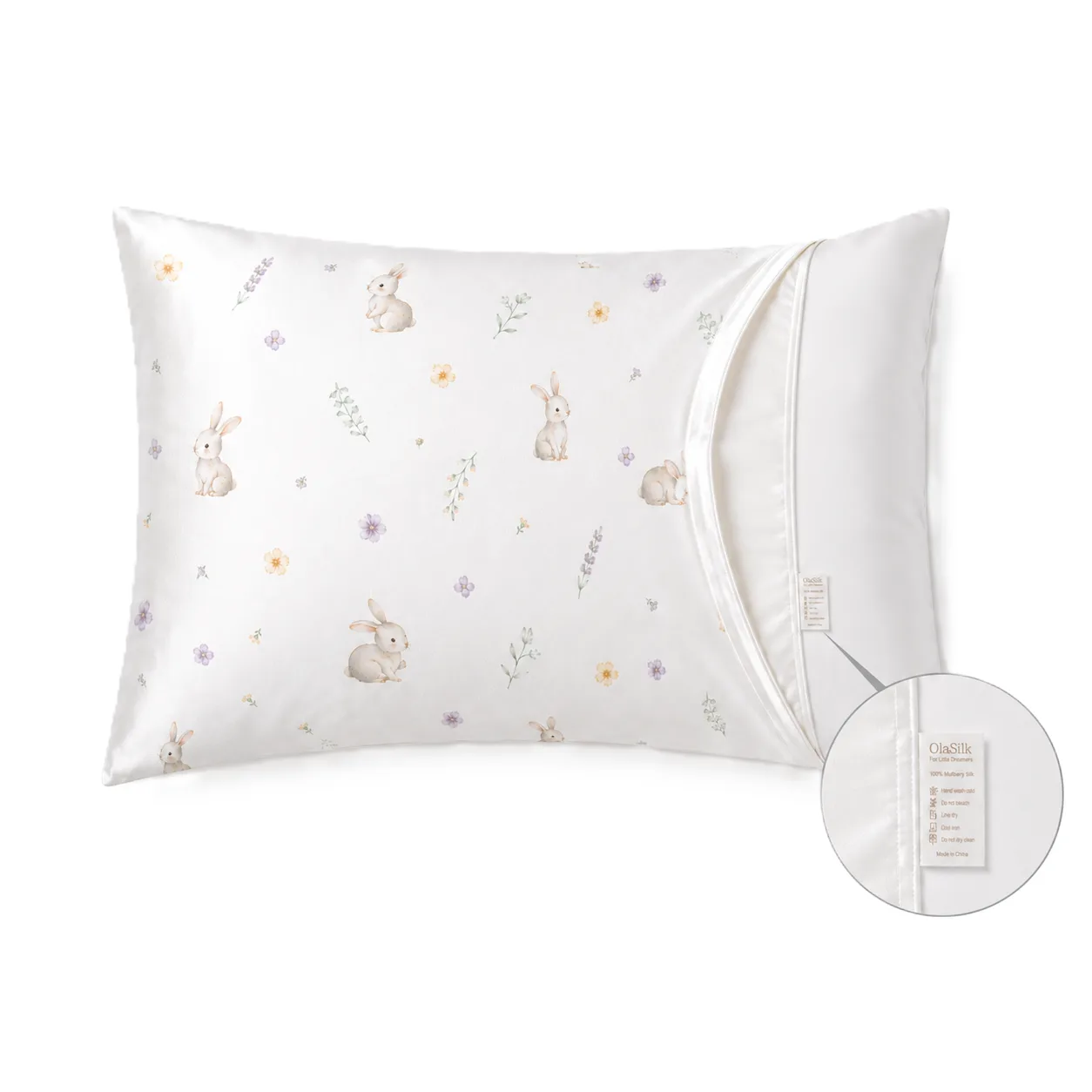
This current owner-page product image shows a visible printed label placement. It cannot confirm the label copy, fibre composition, care basis, product age scope, test status or destination compliance. Confirm those fields against the identified physical sample and controlled evidence file.
Product type is a question set, not a legal classification
Use the product type to start the right questions. Do not turn the table below into a predetermined answer.
| Product direction | Questions to assign before artwork | Physical sample points | Packout points |
|---|---|---|---|
| Pillowcase | Intended user/use, textile coverage, fibre/origin/care basis, identifier and destination owner | Closure, label position, readability and seam interaction | Fold, label visibility, insert, product identity and outer-pack version |
| Pajama or nightwear | Intended user/age input, intended use, textile/apparel path, components, trims and evidence | Size/SKU match, sewn-label placement, trim attachment and copy legibility | Fold, size/colour identification, warning/instruction decision and language |
| Sleep mask or bonnet | Intended use, classification owner, components, elastic/trim list and label path | Fit-direction sample identity, label placement and attachment | Pouch/box identity, component list, instruction decision and pack orientation |
| Scrunchie or hair accessory | Intended user/use, component and attachment review, textile information decision | Elastic, seam, woven/printed label and any decorative part | Count, colour/SKU identity, card or pouch, identifier and language |
| Gift set | Component-level decisions plus the assembled-set identity and destination route | Every included item matches its controlled version | BOM, count, insert, outer-pack identity, barcode supplied by owner and retained packout |
If a decorative part, button, charm, elastic component or attachment changes, reopen the component and evidence review. A clean product photograph does not show attachment strength, test results or the applicable rule decision.
Lock identifiers and responsible-business details across surfaces
Create one controlled source for the product name, SKU, batch or other project identifier, responsible-business details and destination-market wording. Then map that source to the product label, inner packaging, outer packaging and online offer wherever the appointed owner says the information must appear.
Do not ask a designer to reconstruct responsible-business details from a prior PDF. Provide approved text in a controlled field. Treat barcodes and GTINs as buyer- or brand-supplied identifiers unless the project record states another authorized owner. Record which identifier was verified against which SKU; visual scan quality alone does not prove the encoded value belongs to the product.
Separate textile copy from safety and traceability decisions
Keep four groups distinct:
- product identity and traceability;
- fibre, origin and care information;
- warning, instruction and product-safety decisions;
- brand, marketing and packaging copy.
This separation makes missing evidence visible. It also reduces the chance that a certification logo, marketing phrase or care symbol will be treated as proof of a different requirement. If one approved sentence serves more than one purpose, still record the evidence and decision owner for each purpose.
Care wording needs a reasonable product-specific basis where the relevant rule applies. Do not copy a care instruction from another silk SKU merely because the fibre name or momme is similar. Review the whole identified product, its components and the current evidence.
Control artwork version, placement and pack orientation
Use filenames that connect the project, SKU, market, language, artwork type, revision and date. Mark old files superseded rather than deleting the decision trail. The same discipline applies to dielines, inserts, woven labels, printed labels, hang tags, barcode stickers and online listing assets.
For each artwork, record:
- exact filename and revision;
- source copy and evidence owner;
- product or pack surface;
- size and placement reference;
- language and destination;
- print, weave, embroidery or attachment direction;
- sample round and physical proof reference;
- correction ID and approver;
- approved, conditional, revise, open or superseded status.
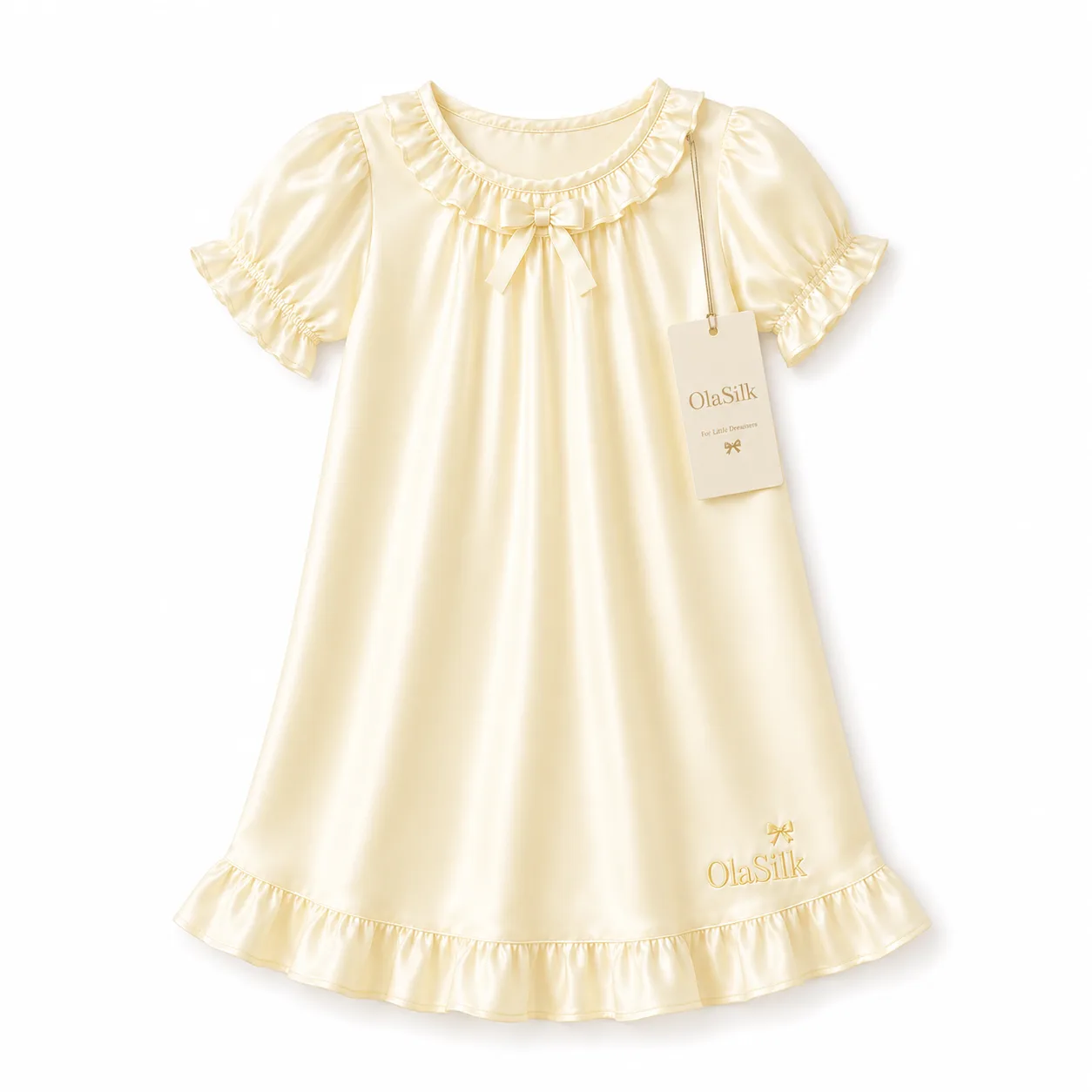
This current owner-page product image shows a visible hang-tag direction. It does not prove the tag copy, fibre content, product classification, age suitability, test status, identifier accuracy or legal placement. Confirm the final artwork on the identified sample and destination record.
Photograph the approved packout from enough angles to show product identity, label location, included components, inserts, orientation and outer-pack version. Link every photo to the same SKU and artwork revision. A photograph without a version cannot control a repeat order.
The private-label silk packaging guide helps separate primary, presentation and shipping layers. The kids silk product series guide can help define the product mix before this record begins.
Kids silk product label and packout checklist
- Every product and component has a project SKU or controlled identifier.
- Intended user or age input and intended use came from the buyer's product owner.
- Destination country or region and sales channel are recorded.
- The buyer, importer or appointed compliance owner is named.
- Product classification and applicable requirements are recorded as owner decisions.
- Every test, certificate or evidence file has a date, source and exact scope.
- Fibre, origin and care decisions are separated from safety and traceability decisions.
- Product, batch or other identifier fields match the controlled source.
- Responsible-business, importer or EU operator details are verified by their owner.
- Warning, instruction, language and placement decisions are explicit.
- Labels, hang tags, inserts, barcode stickers and pack artwork have controlled revisions.
- Components, trims and attachments match the reviewed sample.
- Product, packaging and online-offer fields are mapped where applicable.
- The physical sample and packout photos show the exact SKU and revision.
- Conditional, open and superseded fields have an owner and next evidence.
- The approved sample or retained reference is identified for repeat-order comparison.
The custom silk product sampling checklist connects this artwork record to sample rounds and physical approvals. The private-label silk project guide places it inside the wider development and production handoff.
Who this record may suit
This record is suitable for private-label brands, retailers, distributors and gift-program teams that have selected a kids silk product direction and need to coordinate buyer, importer, compliance, design, sourcing and packaging owners. It may not suit a team that has not yet defined the product, intended user/use or destination market. Those inputs come before artwork.
It also does not replace legal advice, laboratory work or the buyer's applicability decision. Keep unresolved fields open rather than asking a factory or designer to infer them.
OlaSilk is a Qingdao source factory for B2B silk projects. The useful result is a traceable label and packout decision for one identified SKU, destination and evidence set—not a generic compliance promise.
FAQ
Can one kids label file cover every product in a collection?
Not by default. Start with separate SKU, construction, component, intended-use and destination records. The appointed owner can then decide which approved fields or files may be shared.
Does a silk material certificate approve the finished product?
No. Record the material document's exact scope. Finished-product requirements, components, attachments, intended use, testing and destination decisions need their own evidence and owner.
Can OlaSilk decide which warning belongs on a product?
The buyer, importer or appointed compliance owner should determine applicability and authorize the exact wording. OlaSilk can place approved copy into a controlled sample and packout record.
Should the barcode be tested during packout review?
Verify that the buyer-supplied identifier is assigned to the correct SKU, the printed code matches the controlled value and the physical sample can be scanned in its actual placement. A successful scan does not by itself verify legal applicability or product identity outside that controlled record.
What should happen when a destination or component changes?
Open a new revision. Recheck the classification, evidence, copy, identifier, placement and packout fields affected by the change. Do not carry the old approval forward without review.
Prepare a kids silk label and packout RFQ
Share the exact SKU list, intended user or age input, intended use, destination market, sales channel, component and trim list, required test or certificate files from your compliance owner, approved label copy, product or batch identifier, responsible-business details, warnings or instructions, artwork files, packaging format, quantity range, target timing and every field that is still open.