Silk Blouse Fit Sample Specification: POM, Seam Construction and Drape Comments
Use one controlled silk blouse fit-sample record to connect points of measure, construction observations, drape comments, corrections and approval status before bulk discussion.

Review the matched product or buyer guide selected in this article.
On this page
- Quick answer: approve the sample, method and revision together
- Identify the exact sample before measuring
- Build a project-specific point-of-measure table
- Review construction at named locations
- Separate drape comments from measurement comments
- Connect comments to photos without letting photos replace the record
- Control material and momme as project inputs
- Record corrections as controlled changes
- Check labels and care information within the destination scope
- Silk blouse fit sample checklist
- Who this record is suitable for
- FAQ
- Should measurements be checked before visual fit comments?
- Can a supplier image define the blouse size chart?
- Should a substitute-fabric fit sample be approved?
- How should comments be written for the next sample?
- Does an approved fit sample approve future bulk production?
- Prepare a silk blouse fit-sample RFQ
A silk blouse fit sample specification should connect the physical sample to one measurement method, one construction review and one dated decision record. Private-label buyers need more than a list of numbers: they need to know which sample was measured, where each point of measure starts and ends, how the blouse hangs on the intended body or form, what changed from the previous round, and which open comments must be resolved before bulk discussion.
Buyer decision: use the record to decide whether the identified sample passes, passes with a named condition, needs revision or is still waiting for evidence. A product image can show a visible neckline, sleeve, hem or silhouette direction. It cannot confirm actual measurements, tolerance, seam allowance, internal finishing, wearer comfort, production consistency or approval status.
Quick answer: approve the sample, method and revision together
Before reviewing fit, identify:
- project, style code, sample round and specification revision;
- sample date, colour and size under review;
- intended customer, sales channel and fit direction;
- the approved reference pattern, technical drawing or previous sample;
- point-of-measure IDs, landmarks, method and project target;
- actual sample measurements and project tolerance;
- construction observations by location;
- fit and drape comments tied to a body area or garment panel;
- correction, owner, due evidence and next sample round;
- pass, conditional, revise, open or superseded status;
- dated photos and the retained physical sample or reference.
The custom silk clothing owner page remains the broad commercial owner for private-label apparel. This guide handles a narrower search and buying task: building a controlled record for one selected blouse fit sample.
Identify the exact sample before measuring
Put the sample identity at the top of every page and photo set. A project name alone is not enough when two rounds, colours or sizes are on the table. Mark the garment with the style code, sample round, specification revision, review date and size. If a second garment is used for comparison, give it a separate sample ID.
Record the intended fit direction in plain language. For example, a buyer may be reviewing a relaxed shirt silhouette, a shaped blouse with waist suppression, a tie-neck blouse or a cropped wrap direction. That statement is not a measurement target by itself; it tells the reviewer what the project is trying to achieve and helps explain why a correction is being requested.
Do not reuse a measurement table from a scarf, pajama block or another blouse simply because the materials or visual direction look related. The active record should belong to the identified pattern, sample and project.
Build a project-specific point-of-measure table
A point of measure, or POM, needs an ID, a named start and end landmark, and a repeatable method. “Chest” can mean a flat width, a circumference, a position below the armhole or another project definition. The record should remove that ambiguity before two people measure the same garment.
Measure the sample in the agreed condition and state that condition. Record whether closures are fastened, the garment is laid flat without stretch, pleats are opened or closed, and curved areas follow a straight or contour method. Use the project's own units and tolerance. Do not import numeric tolerances from a search result, another supplier or an unrelated programme.
| POM ID | Review area | Project landmark and method | Project target | Actual sample | Project tolerance | Result | Comment or correction |
|---|---|---|---|---|---|---|---|
| P01 | Body length | Name the shoulder or neckline start and hem endpoint | Controlled project value | Measured value | Project value | Pass / out | State location and effect |
| P02 | Chest | Define level, flat or circumference method, and closure state | Controlled project value | Measured value | Project value | Pass / out | Link to fit observation |
| P03 | Shoulder | Define seam-to-seam or other approved landmarks | Controlled project value | Measured value | Project value | Pass / out | Note balance or seam position |
| P04 | Sleeve length | Define shoulder, armhole or centre-back starting method | Controlled project value | Measured value | Project value | Pass / out | Link to cuff position |
| P05 | Sleeve opening or cuff | Define closure and flat measurement method | Controlled project value | Measured value | Project value | Pass / out | Note access and appearance |
| P06 | Hem or bottom opening | Define flat width or circumference and side-seam position | Controlled project value | Measured value | Project value | Pass / out | Link to drape and sweep |
Replace every placeholder with the project's controlled values. This table is a decision format, not an OlaSilk universal size chart or tolerance standard.
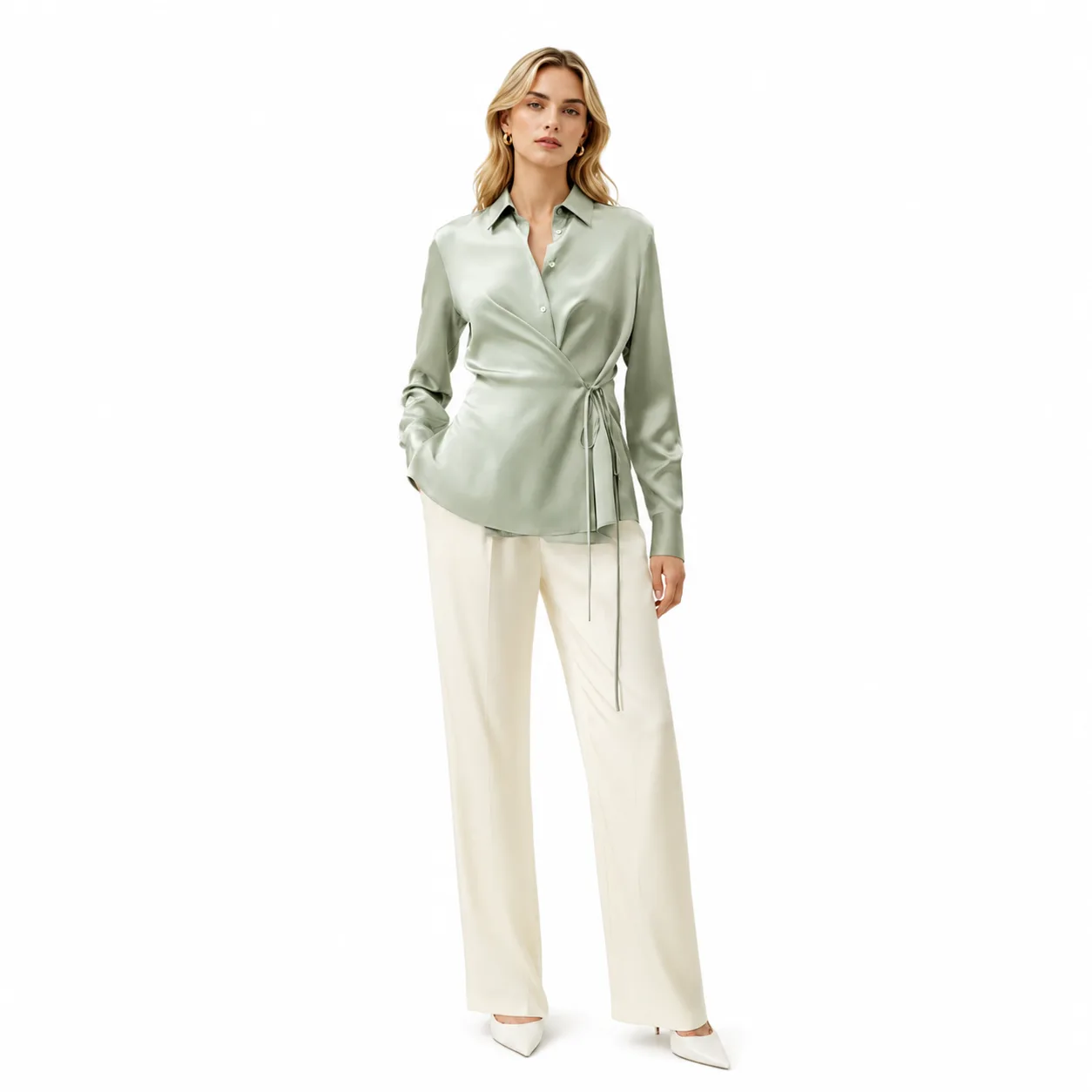
This real OlaSilk image shows one visible silk blouse direction. It can support a discussion about visible neckline, sleeve and silhouette choices, but it does not show the actual POM values, internal seams, pattern balance, tolerance or fit approval. Confirm those points on the identified physical sample.
Review construction at named locations
Measurement and construction reviews belong in the same sample record, but they should not be collapsed into one vague comment. A blouse can meet listed dimensions while still having an unintended seam position, collar roll, placket behaviour, sleeve rotation or hem finish.
Review construction by location:
- neckline, collar or tie attachment;
- shoulder seam and any yoke;
- armhole and sleeve setting;
- dart, pleat, gather or panel junction;
- centre-front opening, placket and button placement;
- cuff, sleeve opening and closure;
- side seam and underarm intersection;
- hem shape, finish and transition at the side seam;
- label, logo or trim position when included in this sample round.
Write what is visible on this sample before writing the requested correction. “Improve sewing” does not tell the next sample maker where the issue sits or what the buyer expects to see. A useful note identifies the area, the observed condition, the controlled reference and the requested result.
If internal finishing is not visible in the available photographs, leave it open until the physical sample or a controlled construction photo can be reviewed. Do not turn a clean exterior image into evidence of hidden seam construction.
Separate drape comments from measurement comments
Silk blouse review needs both dimensional and visual observations. A number can describe where a point sits; it cannot fully describe how the fabric falls between points, how fullness distributes, or how the front and back balance appear on the intended body or form.
Record drape comments by garment zone and viewing condition:
| Zone | Observation on identified sample | Related POM or construction | Buyer decision | Next evidence |
|---|---|---|---|---|
| Neckline and upper chest | Describe opening, collapse, pulling or excess only if observed | Neckline, shoulder, chest, facing | Pass / conditional / revise / open | Revised sample or named photo |
| Front body | Describe hang, drag lines, fullness or placket behaviour | Chest, waist, front length, dart or pleat | Pass / conditional / revise / open | Revised sample on agreed form |
| Back body | Describe balance, shoulder-blade ease or hem level | Back width, shoulder, back length | Pass / conditional / revise / open | Back and side views |
| Sleeve | Describe rotation, fullness, pitch or cuff position | Armhole, sleeve length, bicep, cuff | Pass / conditional / revise / open | Arm-down and movement views |
| Hem | Describe level, curve, side transition or sweep | Front/back length, bottom opening | Pass / conditional / revise / open | Front, side and back views |
State whether the review uses a dress form, fit model or another controlled setup. A fit-model comment should identify the size and relevant project basis without exposing personal information. Comfort and movement comments should be recorded as observations from the defined review, not as universal promises.
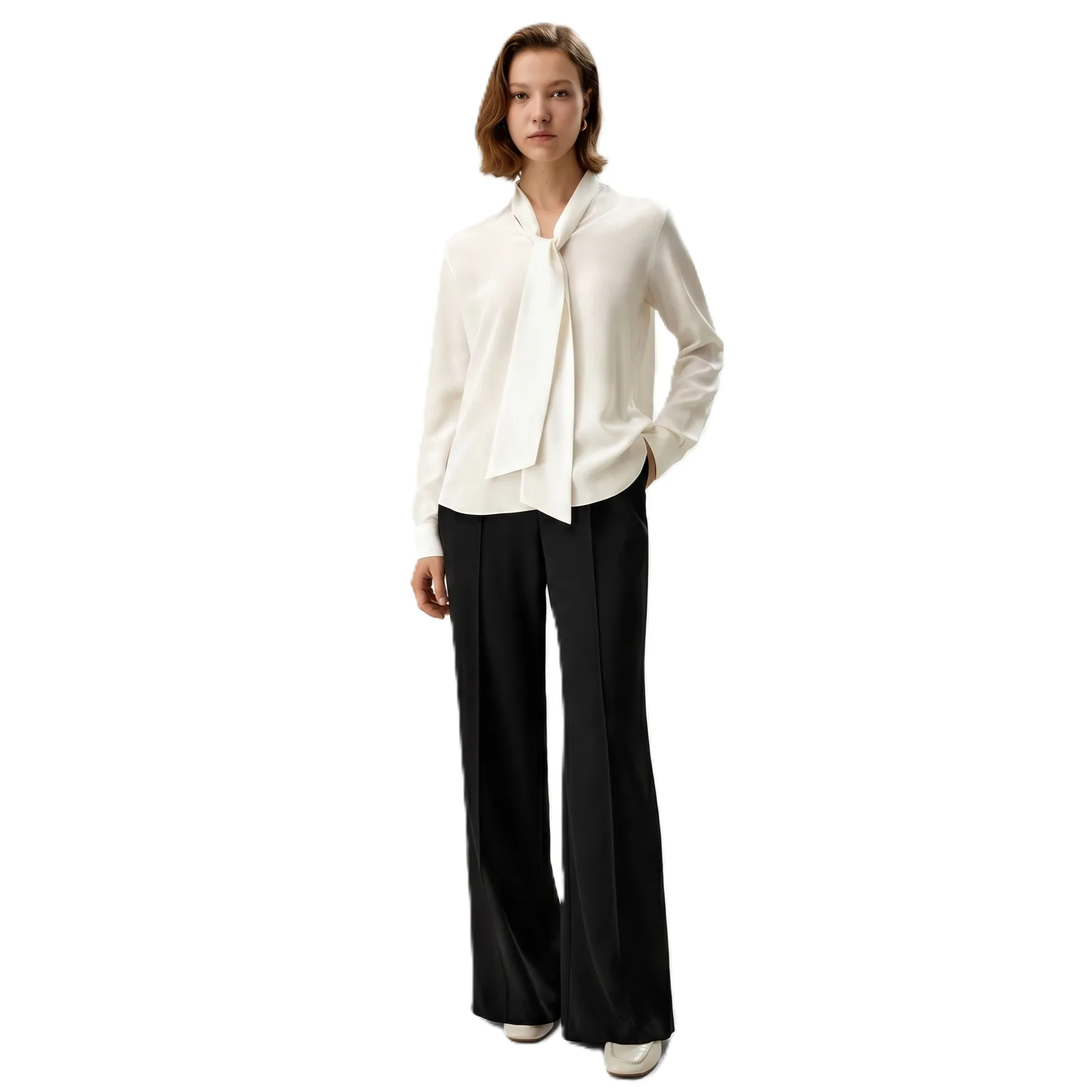
This real OlaSilk image shows a visible tie-neck, cuff and sleeve-volume direction. It does not prove the fabric specification, momme, dimensions, tolerance, wearer comfort or construction approval for a buyer's sample.
Connect comments to photos without letting photos replace the record
Use a consistent photo set for every sample round: front, side, back and close-ups of each named issue. Add the sample ID, round, date and comment number to the file or caption. A marked-up image should link back to the same correction ID used in the measurement and construction tables.
Keep neutral lighting and a comparable camera position where practical. If colour is part of the review, connect the image to the project's physical colour reference and comparison method. Screen appearance alone cannot approve physical colour.
Photos are evidence of what was visible at a moment. They do not replace actual measurements, hidden construction review, a signed decision or the retained sample. If an image is used only as a visual reference, say so.
Control material and momme as project inputs
The fit record should name the selected fabric direction and project-specific momme where confirmed because material behaviour affects the review context. It should not assume that one weight or weave suits every blouse.
Use the physical sample and swatch set to review the selected material direction. Record whether the sample was made in the intended material or a substitute, because a substitute sample may answer some pattern questions while leaving drape, opacity, surface or finishing decisions open. If the material changes, identify which fit and construction observations need to be reviewed again.
OlaSilk project support can include 100% mulberry silk, project-specific momme, colour, print, logo, label and packaging directions. Those options still need to be selected and confirmed for the actual blouse project; they are not automatic attributes of every sample shown here.
Record corrections as controlled changes
Every requested change should have an ID, location, observation, requested result, owner and next evidence. If a correction changes a measurement, construction or material input, update the specification revision and state which previous approval is affected.
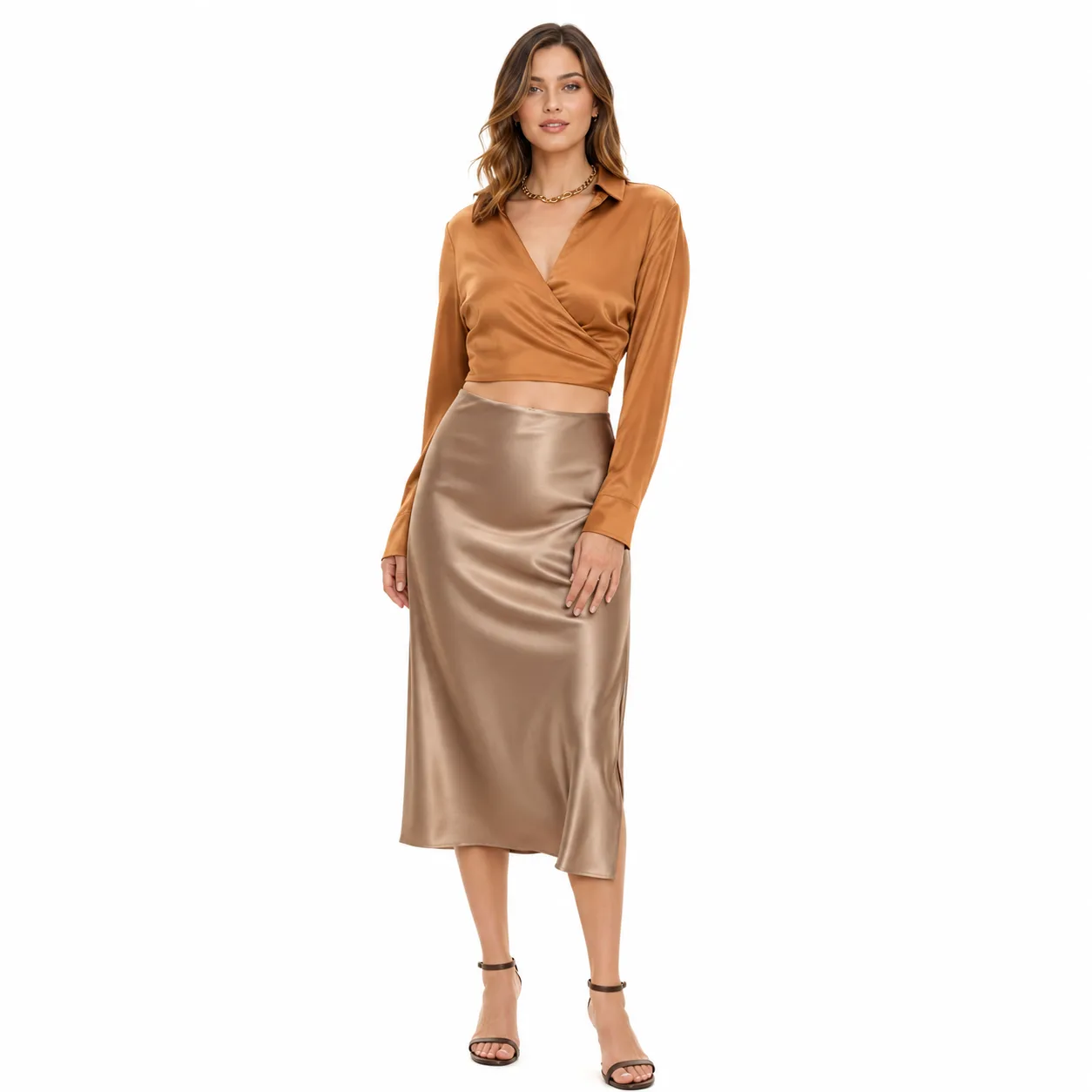
This real OlaSilk image shows a visible wrap and tie direction from front and back. It cannot confirm pattern balance, tie dimensions, seam strength, fit, material composition or approval. Review those fields on the identified sample and controlled specification.
Use status words consistently:
| Status | Meaning | Required next step | Evidence retained |
|---|---|---|---|
| Pass | The identified sample meets the listed targets for this review | Protect the approved revision | Signed record, sample ID and retained reference |
| Conditional | A named condition must be verified before closure | Assign owner and required evidence | Current sample, condition and follow-up |
| Revise | A controlled change and another review are needed | Issue next specification and sample revision | Observation, correction and superseded record |
| Open | A buyer decision or evidence item is missing | Name the question, owner and due date | Open item and current evidence |
| Superseded | A newer controlled version replaces this one | Prevent reuse in the active file set | Version history and replacement link |
Do not overwrite a failed or superseded observation. The version history explains why the next sample exists and prevents a team from comparing garments made to different files.
Check labels and care information within the destination scope
Label and care requirements depend on the product, claims and destination market. For U.S. apparel, the Federal Trade Commission's Care Labeling Rule guidance explains that manufacturers and importers need a reasonable basis for care instructions and should account for the garment and its components. It does not supply one care instruction for every silk blouse or approve a project label.
Record the intended market, the controlled label artwork and the evidence owner. Keep certification references within their verified scope. OEKO-TEX Standard 100, Sedex and ISO 9001 references do not by themselves prove fit, care performance, seam strength, destination compliance or the quality of a particular blouse sample.
Silk blouse fit sample checklist
- Project, style code, sample round, colour, size and specification revision match.
- Intended customer, sales channel and fit direction are written down.
- The physical sample and retained reference have clear IDs.
- Every POM has named landmarks, method, target, actual and project tolerance.
- Measurement condition and closure state are recorded.
- Neckline, shoulder, armhole, sleeve, front opening, side seam and hem were reviewed.
- Fit and drape comments name the garment zone and viewing setup.
- Every comment links to a correction ID, owner and next evidence.
- Material, weave and project-specific momme status are clear.
- Any substitute material and its remaining review limits are recorded.
- Colour, logo, label and trim files use controlled revisions.
- Destination-market care and label questions have evidence owners.
- Pass, conditional, revise, open or superseded status is dated.
- Front, side, back and issue-detail photos match the sample ID.
- A retained physical sample or dated retained reference is identified.
The custom silk product sampling checklist can connect this blouse-specific record to the wider colour, branding, packaging and sample-round process. The private-label silk project guide explains how a controlled sample fits into the broader project sequence.
Who this record is suitable for
This record is suitable for fashion labels, boutique retailers and private-label apparel teams that have selected a silk blouse direction and need to control a fit sample before bulk discussion. It may not suit a team that is still choosing between a blouse, dress or another product family. Select the product and intended customer first, then define the fit direction and sample record.
It also may not close questions that require another specialist review, such as destination legal requirements, laboratory testing or a fit decision that the buyer has not yet made. Keep those items open with named evidence rather than writing them as approved.
OlaSilk is a Qingdao source factory for B2B silk projects. The useful outcome of this process is not a generic fit claim. It is a traceable decision about one identified blouse sample, its controlled inputs and its next action.
FAQ
Should measurements be checked before visual fit comments?
Start by confirming the sample identity and measuring it against the controlled POM method. Then record construction, fit and drape observations. This helps separate a dimensional difference from a construction or balance issue.
Can a supplier image define the blouse size chart?
No. An image can show a visible style direction. Use the project's pattern, POM landmarks, measurement method, target values and physical sample for size and fit decisions.
Should a substitute-fabric fit sample be approved?
It may answer some pattern or construction questions, but the record should identify the substitute and keep material-dependent drape, surface, opacity or finishing decisions open until the intended material is reviewed.
How should comments be written for the next sample?
Name the location, observed condition, controlled reference, requested result, owner and next evidence. Link the comment to a photo and revision instead of using a general instruction.
Does an approved fit sample approve future bulk production?
The record approves only the stated scope for the identified sample and revision. Bulk consistency, production checks and any later material or construction changes need their own control.
Prepare a silk blouse fit-sample RFQ
For a project-specific feasibility review, share the intended customer and sales channel, blouse reference, size range, fit direction, technical drawing or pattern status, POM table, selected silk and momme direction, colour or print reference, construction details, logo and label files, packaging direction, quantity range, destination market, target timing and the questions that still need development support.