Silk Pajama Sample Size Specification: Measurements, Tolerances and Labels
Build a private-label silk pajama sample size specification that keeps points of measure, measuring methods, target values, agreed tolerances, sample actuals, fit comments, labels and revision decisions in one controlled record.

Review the matched product or buyer guide selected in this article.
On this page
- Quick answer: approve the method and revision, not “size M”
- Identify the style, sample type and governing file
- Define each point of measure and how to take it
- Keep target, tolerance and actual value in separate fields
- POM measurement and sample review table
- Review fit comments alongside measurements
- Decide whether a size-set sample is still required
- Connect fibre, origin, care, brand and size labels to the revision
- Version-control and sample-approval checklist
- Who this workflow is for
- FAQ
- Is a body size chart enough for a pajama sample?
- Can one tolerance apply to every POM?
- Does an in-tolerance sample automatically pass fit?
- When should a size-set sample be reviewed?
- What evidence should be retained after approval?
- Prepare a size-specification RFQ
A silk pajama sample should be reviewed against a controlled size specification, not against the words “size M” or a generic body chart. The useful record names the style and sample revision, defines every point of measure and measuring method, separates the target from the agreed tolerance and actual sample value, and links any fit or construction comment to an owner and next action.
Buyer decision: approve one measurement method and one current revision before deciding whether the sample can move to a size set, another fit round or a production discussion. A product image can show a visible pajama direction; it cannot confirm measurements, body fit, tolerance compliance, label accuracy or bulk consistency.
Quick answer: approve the method and revision, not “size M”
Two reviewers can measure the same garment differently if the preparation, orientation, measuring points or tape path are not defined. A useful sample size specification therefore records:
- style code, sample type, base size and tech-pack revision;
- point-of-measure code and plain-English name;
- a diagram or written measuring method;
- target measurement and project-agreed unit;
- project-agreed plus/minus tolerance;
- actual sample measurement and difference from target;
- fit or construction observation, required action and owner;
- label, artwork and packaging revision connected to the sample;
- decision status, approver, date and retained reference.
Start with the custom silk pajamas owner page to compare current OlaSilk sleepwear directions. This article controls sample measurement and approval only; it does not create a universal size chart or replace a project specification.
Identify the style, sample type and governing file
Put the sample identity at the top of every measurement sheet. Record the project name, style code, garment description, sample round, received date, base size, requested size range, fabric direction, colour, trim revision and tech-pack version. Photograph or label the physical sample with the same working identity.
A proto sample, fit sample, size-set sample and pre-production sample answer different questions. Do not carry a measurement forward merely because it appeared on an earlier sheet. Record which sample type is being reviewed and which file is authoritative for that round.
If a previous sample remains relevant, retain its measurement sheet and comments as history. Mark the newer revision clearly instead of overwriting the old observations. This makes it possible to see whether a requested correction was applied or whether a new construction change created another measurement issue.
Define each point of measure and how to take it
A point-of-measure name is not complete without a method. “Chest,” “body length” or “sleeve” can produce different values depending on where the garment is placed, how it is smoothed and where the tape begins and ends.
For each POM, define:
- whether the garment is buttoned, tied, relaxed, opened or otherwise prepared;
- whether it is laid flat and smoothed without stretching;
- the front, back or combined panel being measured;
- the exact start and end landmarks;
- whether the tape follows a straight line, edge, curve or seam;
- whether an elastic, belt, cuff, placket or gathered area is relaxed;
- the unit and rounding rule used in the project record.
Use a marked diagram or annotated photograph where words could still be interpreted in more than one way. The diagram defines where to measure; it does not prove that the received sample matches the target.

This real OlaSilk pajama image shows the visible product direction and garment orientation. It does not confirm any point of measure, target value, tolerance, body fit, fibre result or approval status. Those items still need a controlled method and physical sample review.
Keep target, tolerance and actual value in separate fields
The target is the intended project measurement. The tolerance is the project-agreed variation allowed for that specific POM and review stage. The actual is what the reviewer records on the identified physical sample. Do not combine the three into one cell or replace the target after seeing the sample.
Calculate and record the difference between actual and target. Then classify the row using an agreed decision language such as `pass`, `conditional`, `revise` or `open`. A value outside tolerance is evidence for a review, not an automatic diagnosis of the cause. Pattern, construction, pressing, fabric behaviour, measuring method or an incorrect sample identity may all need investigation.
Do not copy a universal tolerance from another supplier or article. The acceptable range depends on the garment, POM, construction, material, sample stage and brand requirement. The project team should agree it before using the sheet as an approval record.
POM measurement and sample review table
Use one row per measurement and keep the method reference stable across revisions.
| POM / code | How measured | Target | Agreed tolerance | Sample actual | Difference | Fit or construction note | Decision / owner |
|---|---|---|---|---|---|---|---|
| Chest / project code | Named flat-garment landmarks and state | Project value | Project value | Observed value | Actual minus target | Link to dated comment or image | Open / pass / conditional / revise |
| Body length / project code | Named shoulder or neckline start to hem endpoint | Project value | Project value | Observed value | Actual minus target | Record balance, hem or construction note separately | Decision and owner |
| Sleeve / project code | Named shoulder or armhole point to finished cuff | Project value | Project value | Observed value | Actual minus target | Record cuff and seam observation separately | Decision and owner |
| Waist / project code | Named waistband state and tape path | Project value | Project value | Observed value | Actual minus target | Note elastic or tie state without stretching | Decision and owner |
| Trouser length / project code | Named waist reference to finished hem | Project value | Project value | Observed value | Actual minus target | Link rise, inseam or hem issues to their own rows | Decision and owner |
The row names above are examples of record structure, not a finished pajama specification. Add, remove and define POMs for the actual style. Never fill a project sheet with assumed measurements simply to make it look complete.
Review fit comments alongside measurements
A garment can measure inside tolerance and still need a fit or construction decision. It can also measure outside tolerance without producing the expected fit issue. Keep numeric evidence and fit observations connected but separate.
For a fit review, record the identified wearer or form, any relevant body reference supplied by the brand, the garment state, the view and the exact observation. Use dated images or comment tags to point to the location. Avoid vague comments such as “make it better” or “fit is wrong.” State the observed issue, proposed action, responsible party and evidence required for the next review.
Construction changes can alter measurements. A collar, cuff, waistband, piping, button position, belt loop, pocket or seam change should be linked to the affected POM rows and revision. Do not approve measurements on one construction while the next sample silently uses another.
The wider custom silk product sampling checklist can connect fit evidence to material, colour, branding, packaging and sample-round decisions.
Decide whether a size-set sample is still required
Approving a base-size fit sample does not prove the full requested size range. Decide whether the project needs a size set and which sizes should be physically reviewed. Record the grading inputs, POM relationships and any construction or trim that changes across sizes.
A size-set review may not suit a project that is still changing the base pattern, fabric, waistband, closure or key trim. Close those upstream variables first, or record clearly why a limited review is still useful. When the base size is stable, use the size set to test whether the intended measurement relationships and construction remain coherent across the selected sizes.
Do not invent universal grade rules. The brand's fit direction, market, garment shape and approved base pattern determine the project inputs. Preserve the decision history when a grade rule is adjusted.
Connect fibre, origin, care, brand and size labels to the revision
Label review belongs in the same approval system because a correct garment with the wrong label version is not a closed sample. Record label type, controlled artwork or text file, position, attachment method and sample revision. Check the visible physical label against the approved file; do not rely on a typed description alone.
For the United States, the FTC explains that most covered textile products need fibre content, country of origin and the identity of the manufacturer or another responsible business, while clothing care instructions are governed by a separate care-labelling rule. Destination markets can differ, so this article is not legal advice and does not supply a global label template.
OlaSilk is a Qingdao source silk factory for B2B private-label projects. Current pajama development can use 100% mulberry silk with project-specific momme, size, colour, logo, label and packaging choices. References to OEKO-TEX Standard 100, Sedex or ISO 9001 support must stay within the verified and applicable scope; they do not prove garment fit, label compliance, tolerance acceptance or bulk results for a named project.
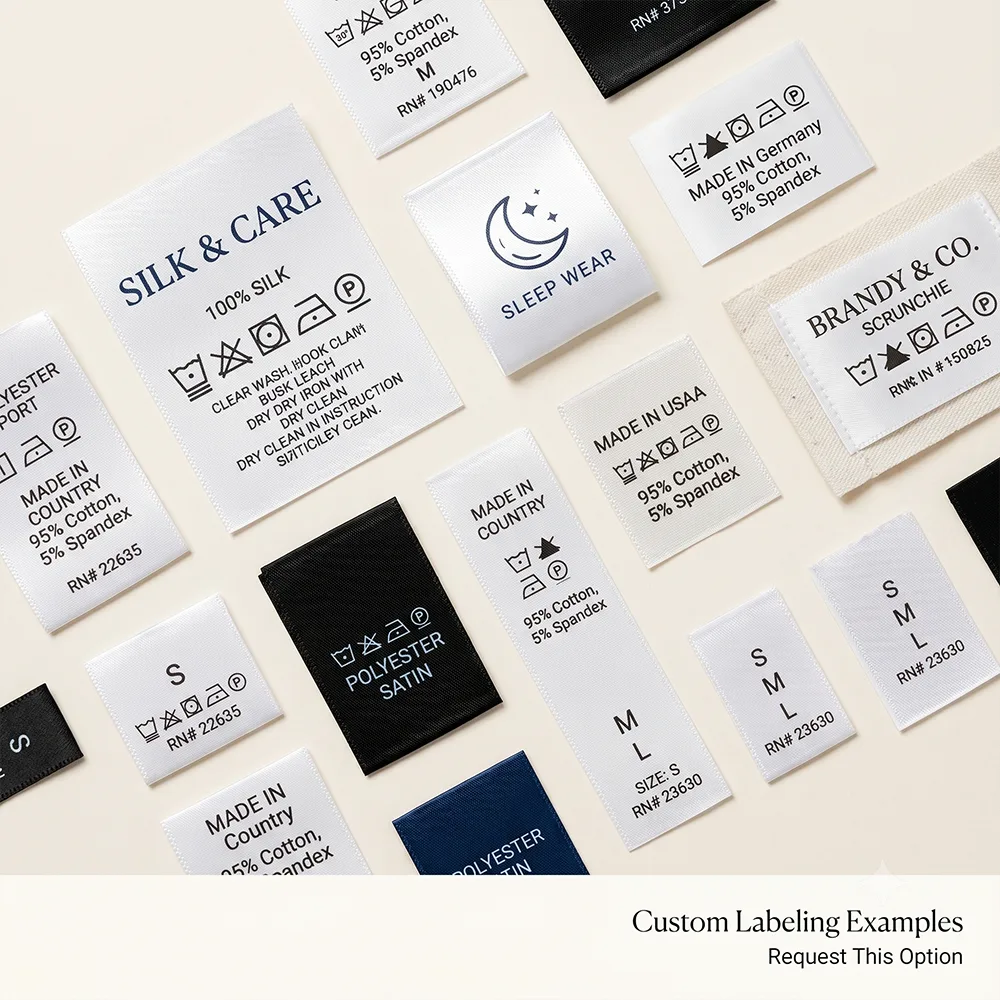
This real OlaSilk image shows a printed care-label direction. It cannot confirm the destination-market wording, fibre declaration, origin, business identity, attachment, wash result or approval status for another garment. Confirm the controlled copy and physical position on the named sample.
Version-control and sample-approval checklist
- Project, style code, garment description and current tech-pack revision match the physical sample.
- Sample type, base size, requested range, fabric, colour and trim revision are recorded.
- Every POM has a stable code, name, unit and measuring method.
- The garment preparation and tape path are defined without stretching or guesswork.
- Target, tolerance, actual and difference occupy separate fields.
- Out-of-tolerance rows have a named investigation or correction owner.
- Fit observations are specific, dated and linked to the relevant measurement or construction.
- Pattern, construction or trim changes are connected to affected rows and revisions.
- The need for a size-set sample and selected sizes has been decided explicitly.
- Fibre, origin, care, brand and size label files and positions are tied to this revision.
- Packaging or folding has not hidden an unresolved garment or label issue.
- Pass, conditional, revise or open status is signed, dated and connected to retained evidence.
The private-label silk packaging guide can help connect the approved garment and label revision to the pouch, insert, fold and box plan. Packaging approval should not overwrite an unresolved fit or measurement decision.
Who this workflow is for
This workflow is suitable for sleepwear, beauty, spa, hotel and gift brands that have selected a pajama direction and need a repeatable sample review before a size set or production discussion. It may not suit a team that has not yet defined the base style, intended size range or fit direction. Those decisions should be narrowed before a tolerance table is treated as an approval tool.
Brands still comparing broader materials and product routes can review the silk fabrics and material direction and how private-label silk projects work before opening a measurement record.
FAQ
Is a body size chart enough for a pajama sample?
No. A body chart describes intended wearer dimensions or market references. A garment specification defines physical points of measure, methods, targets, tolerances and sample actuals for the identified style.
Can one tolerance apply to every POM?
Do not assume so. Each tolerance should be agreed for the actual POM, construction, material and review stage. This guide intentionally does not provide universal numbers.
Does an in-tolerance sample automatically pass fit?
No. Record the measurement and fit observation separately. An in-tolerance garment can still require a fit or construction change, while an out-of-tolerance value needs investigation before the cause is known.
When should a size-set sample be reviewed?
Review it after the base pattern and key construction are sufficiently stable, using the project-defined grading inputs and selected sizes. Record any remaining exceptions instead of treating one base-size approval as proof of the full range.
What evidence should be retained after approval?
Retain the signed specification, measurement-method references, actual measurements, fit comments, controlled label files, dated images, change history and the identified physical sample or approved sample reference.
Prepare a size-specification RFQ
For a useful feasibility review, share the pajama style or reference, intended base size and size range, silk and momme direction, point-of-measure list, measuring methods, target values, project tolerances, current sample comments, colour, logo and label files, packaging direction, quantity range, destination market and target timing. Mark which fields are approved and which still need sample-development advice.